

How To Create Bootable Usb Windows 10 From Iso Image
Here's a look at using the utility called Rufus to create a bootable USB flash drive for Windows 10 which is actually much faster than Microsoft's tool.
Usually, when we cover creating bootable USB drives for Windows, we recommend the Windows 7 USB/DVD Download Tool (time to update that name Microsoft). Still, I've had some problems creating one and started looking for a different option.
So this time around, I thought I would try the free utility called Rufus. Here's a look at using it, and in the end, I had a faster experience using it than the older Microsoft tool.
Update: To get the ISO for the official release of Windows 10, head to this Microsoft page and download the 64 or 32-bit version of the media creation tool. It will allow you to upgrade your Windows 7 SP 1 or Windows 8.1 PC or download the ISO to use later for a clean install. Also, make sure to check out our piece on creating a Windows 11 bootable flash drive.
For more on that, please read our article: How To Download Windows 10 ISO for a Clean Install.
Create Windows 10 Bootable USB Drive
First, make sure you download the Windows 10 Technical Preview by joining the Windows Insider Program, as explained in this article. Also, make sure you're using a USB drive at least 4 GB for the 32-bit version and 8 GB for the 64-bit version.
One of the first cool things about Rufus is that no installation is necessary, which means you can stick it on a network location or another external drive to run it. When you run it, setting it up is simple. Select the USB drive you want to use, select your partition scheme – it's worth noting that Rufus also supports a bootable UEFI drive.
Then select the disc icon next to the ISO drop-down and navigate to the location of your official Windows 10 ISO.
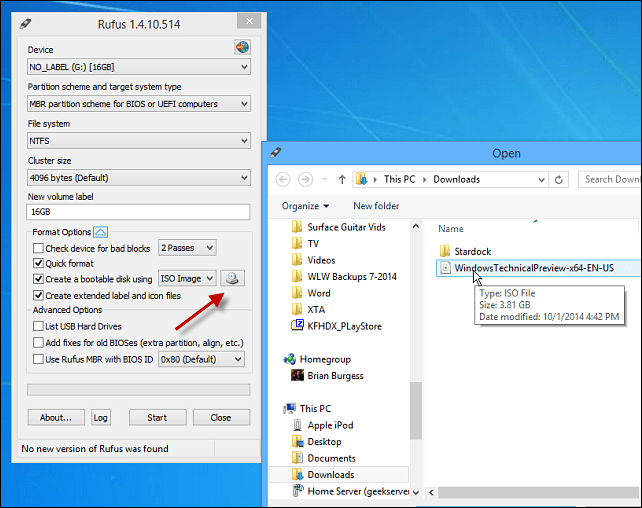
After that, click Start, and you should be good to go within minutes. If you want to be extra careful, check the option to check the device for bad blocks. I didn't do that, and my bootable drive turned out fine.
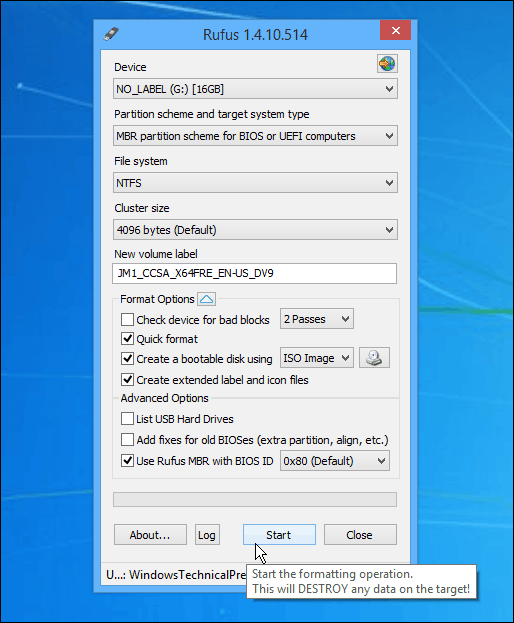
In my experience, using the older USB 2.0 port and drive, it took less than five minutes to create the drive. If you use a USB 3.0 or 3.1 device, I would love to know how fast that works.
Anyway, after it's created, you can go ahead and install the Windows 10 Technical Preview on a spare computer.
Let us know what you think of this tool over Microsoft's Windows 7 USB/DVD Tool; for me, I will continue to use Rufus – at least until Microsoft updates or recreates a new utility – if it does at all.
And yes, of course, you can use this to create other versions of Windows or Linux distros from an ISO if you wish.

How To Create Bootable Usb Windows 10 From Iso Image
Source: https://www.groovypost.com/howto/create-windows-10-bootable-usb-flash-drive/
Posted by: bishopknoton.blogspot.com
0 Response to "How To Create Bootable Usb Windows 10 From Iso Image"
Post a Comment